By Adam Mejia
Born in the United States we are raised with national pride to believe we are number one in all aspects to life. We are the strongest, smartest, and healthiest nation in this great blue planet, but as we age, we are able to observe things aren’t that simple. Across the board the United states is known as one of the leading nations that spends more funds in our healthcare system per capita but fail to achieve the population outputs of nations that spend much less per capita on healthcare.
As I research for why our healthcare spending is so large, I found a commonality from researchers like Commonwealth Fund Report that specified that mortality rates from illnesses like cancer were not one of the leading causes to death in the unites states, but the rates from illness due to chronic conditions, obesity, and even infant mortality was much higher than compared to other nations across the globe. With those 3 medical traits reflecting the United states greatest healthcare concerns means the attention must be shifted from its current functionality to address the nation’s current medical concern that impacts the greater whole.
The nations inability to solve our health care system even as more funds gets shifted into the healthcare structure is largely criticized as the unhealthy American lifestyle, we have all grown to be accustomed to. Living in America many of our unhealthy eating and lifestyle patterns are much easier to be sought out and fast food becomes a norm making it easy to stay on an unhealthy path. Larger body frames and unhealthy lifestyle choices are socially acceptable, and the idea of a healthy frame gets lost in translation. Through my travels across the globe I have been able to observe that the United States consist of much larger people. In one instance I remember being in Da Nang Vietnam last year and the crowd was all staring and looking at something unusual to them. As I glanced over, I seen a female ranging from age 25 to 32 that was overweight to obese level 1. Thinking nothing off it I asked a friend who spoke the language what was going on. She replied, “that girl is taller and much larger than the people in this side of the world and to them she is extremely obese and out of the norm.” what we consider normal or average in health body types are not projected the same across the globe. We consider being overweight and the medical impairments that it may bring a norm. Grown accustomed to our current unhealthy eating and lifestyle most people don’t want to change and instead seek the immediate gratitude then to keep a path that benefits one self and the nation as a whole. We know obesity is a national issue and concern for many people, but why do we keep reaching for a cookie prior to an apple?
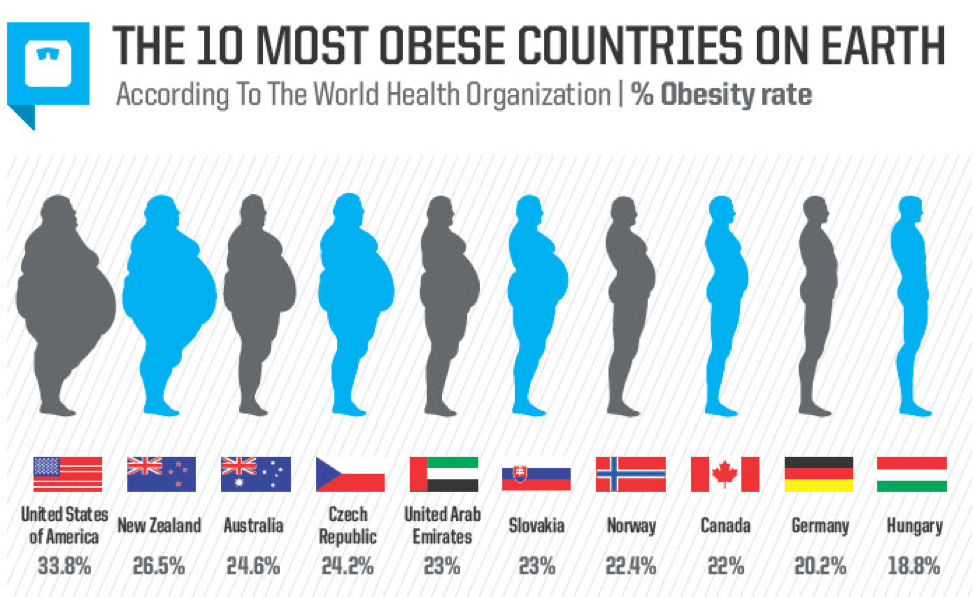
The issue of obesity in or nation is one heard of again and again but no change has made a significant impact. For many years the United States has taken the first-place award for having the largest rate of obesity then anyone other nation it the globe. The chart below lists the top 10 most obese countries on earth. There is no wonder that 33.8 of our nation is considered obese. This is a much larger numbers compared to the second most obese nation New Zealand at 26.5%. As demonstrated, there is a large gap with United States lead of over 7.3% over the second most obese nation and a waping 15% more than many other of the nations like Hungary who still have a larger obese rate then most of the world.
The United States healthcare system faces significant challenges like COID-19 that affect people as a whole and also impact the quality of care seekd for even when needed for other services. The Obesity input has been the nation’s greatest factor for decades that affects more Americans in this fashion, as it prevents each from having greater quality of care due to the obesity issue never gets addressed. Obesity is most commonly due to the individual caring an excess amount of weight or body fat, that in turn may affect the persons health due to body not functioning at its optimal performance. With large obese rates there has also been a trait of also reflects larger medical cost. An analysis by Commonwealth fund found that with the United States who is one of the leading nations in health care spending would spend an average of $9,086 per person annually, life expectancy was 78.8 years. When it comes to Switzerland the second highest nations of obesity also reflected the second highest spending when compared to the nations across the globe, spent $6,325 per person and had a life expectancy of 82.9 years (mohan, 2018.)
If we are to take this data and use it to access the impact of improving health by lowering weight in the United states, then we are able to assume that we are able to lower healthcare spending $2,761 per person. Comparing this again with New Zealand reports we are able to assume that overall health will also be largely impacted as the life expectancy would increase to 82.9 year, 4.1 more years then currently. Because people with obesity are more likely to develop a number of potential health issues consist and are not limited to heart disease, stroke, type 2 diabetes, certain cancers, digestive problems, gynecological and sexual problems, sleep apnea, and osteoarthritis are only some of the key issues provided by Mayo Clinic. The nations rates for members that suffer with medical issues in those areas will also decrease as having a healthy body weight lowers the risk of attracting an illness of that sort. As we have seen not all quality measures have equal impact and prevention on our healthcare as projections ambition, but by drawing attention to the issues to address the nation can use its healthcare spending more wisely to eliminate some of those challenges that may be faced.
In the nation’s healthcare system its evident that citizens often to not acquire the medical needs needed even after the U.S. spends a significant larger amount per person then compared to other nations. To improve open this more resources have been implemented like preventive care that consist of healthcare services that include check-ups, patient counseling, and screenings to prevent illness, disease and other health-related problems (kagan, 2019.)” But many of those benefits only prove to benefit those who are insured but many members in need for medical care who are the uninsured
The lack of quality care services has demonstrated to impact insured, uninsured, and under-insured Americans. “These problems are exacerbated by a lack of coordination of care for patients with chronic diseases. The underlying fragmentation of the health care system is not surprising given that health care providers do not have the payment support or other tools they need to communicate and work together effectively to improve patient care (Brennan, 2019.)”
With our current healthcare structure even though people seek medical attention that does not mean that all get the necessary medical attention. Working in the Emergency Room I noticed many medical resources being implemented in the wrong areas. If a person came in with head aces and was insured then that person would most likely have more medical procedures like a MRI, CT, X-ray, and a variety of labs are done to identify an issue. This creates a large amount of medical resources used that will not have an appropriate impact on the individual’s health but only incorporates a larger cost to that person for medical care and will incorporate a larger cost to address the solution of the problem. By providing an excessive amount of services will cause a “limited evidence on which treatments and procedures are most effective, limited evidence on how to inform providers about the effectiveness of different treatments, and failures to detect and reduce errors further contribute to gaps in the quality and efficiency of care (Brennan, 2019.)”
This impact does only affect the insured but largely the uninsured, as medical cost increase larger the further away uninsured individuals are able to afford the medical treatments needed. Nialle Brennan summarized in her article Improving Quality and Value in the U.S Healthcare System that when it comes to receiving medical care these issues are particularly more relevant to lower-income Americans and to members of diverse ethnic and demographic groups who are in great disparities in health and health care access.
“In 2018, the number of people in the United States without health insurance rose to 27.5 million, up from 25.6 million in 2017. The uninsured rate jumped from 7.9 percent in 2017 to 8.5 percent in 2018. It was the first year-to-year increase in uninsured rates since 2008 and 2009 (Scott, 2019.)”
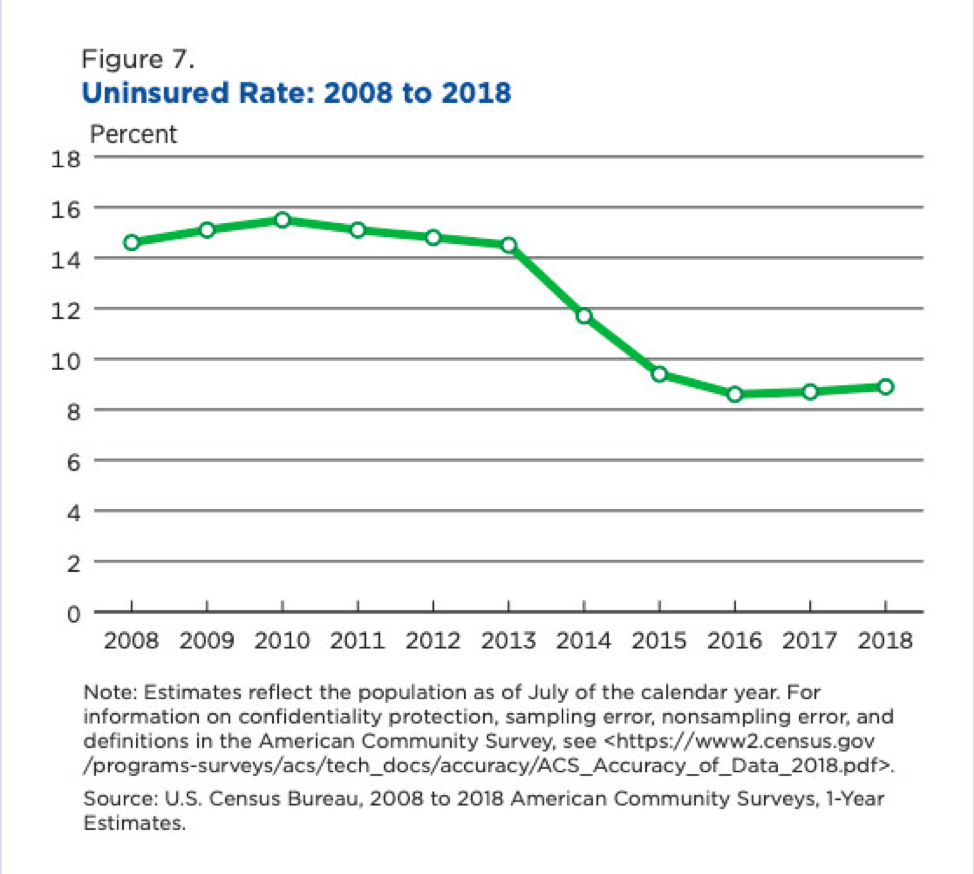
Every person will need medical attention at a certain point in their life. If the person is uninsured then they may not keep medical attention when needed only growing the need for medical care with each passing day. When they finally get medical care, the illness is so advanced that preventative care is not able to help and the medical care cost are much larger. This forces many Americans to decide “do I want to be healthy and in det or clear of det but unhealthy.” With thoughts of this sort the United States health standing will never have a change and only see a greater impact on our health negatively. Knowing when to address issues like obesity so it doesn’t affect one’s health is key to identify before chronic conditions present themselves.
As we have seen not all quality measures have equal impact and prevention on our healthcare as projections ambition, but by drawing attention to the issues to address the nation can use its healthcare spending more wisely to eliminate some of those challenges that may be faced. The evidence for reforming our nations healthcare system demonstrates tremendous potential to aid in not only improving the nation’s health as a whole, but also allocation of resources in the needed areas. In doing so the cost per service will decrease allowing for a more accessible healthcare system then our current functionality.
Word Cited
- Mohan, M. (2019, October 8). U.S. Spends More on Health Care Than Other High-Income Nations But Has Lower Life Expectancy, Worse Health: Commonwealth Fund. Retrieved April 11, 2020, from https://www.commonwealthfund.org/press-release/2015/us-spends-more-health-care-other-high-income-nations-has-lower-life-expectancy
- Kagan, J. (2020, February 5). Preventive Services. Retrieved from https://www.investopedia.com/terms/p/preventive-services.asp
- MayoClinic. (2020, February 15). Obesity. Retrieved April 10, 2020, from https://www.mayoclinic.org/diseases-conditions/obesity/symptoms-causes/syc-20375742
- Brennan, N., Cafarella, N., Kocot, S. L., McKethan, A., Morrison, M., Nguyen, N., … II, R. D. W. (2016, July 28). Improving Quality and Value in the U.S. Health Care System. Retrieved April 11, 2020, from https://www.brookings.edu/research/improving-quality-and-value-in-the-u-s-health-care-system/
- Scott, D. (2019, September 10). The uninsured rate had been steadily declining for a decade. But now it’s rising again. Retrieved April 14, 2020, from https://www.vox.com/policy-and-politics/2019/9/10/20858938/health-insurance-census-bureau-data-trump
- The Commonwealth fund. (2015, October 8). U.S. Spends More on Health Care Than Other High-Income Nations But Has Lower Life Expectancy, Worse Health: Commonwealth Fund. Retrieved April 13, 2020, from https://www.commonwealthfund.org/press-release/2015/us-spends-more-health-care-other-high-income-nations-has-lower-life-expectancy
 Assess Capital Decisions