Be yourself; Everyone else is already taken.
— Oscar Wilde.
This is the first post on my new blog. I’m just getting this new blog going, so stay tuned for more. Subscribe below to get notified when I post new updates.
Be yourself; Everyone else is already taken.
— Oscar Wilde.
This is the first post on my new blog. I’m just getting this new blog going, so stay tuned for more. Subscribe below to get notified when I post new updates.
By Adam Mejia
Born in the United States we are raised with national pride to believe we are number one in all aspects to life. We are the strongest, smartest, and healthiest nation in this great blue planet, but as we age, we are able to observe things aren’t that simple. Across the board the United states is known as one of the leading nations that spends more funds in our healthcare system per capita but fail to achieve the population outputs of nations that spend much less per capita on healthcare.
As I research for why our healthcare spending is so large, I found a commonality from researchers like Commonwealth Fund Report that specified that mortality rates from illnesses like cancer were not one of the leading causes to death in the unites states, but the rates from illness due to chronic conditions, obesity, and even infant mortality was much higher than compared to other nations across the globe. With those 3 medical traits reflecting the United states greatest healthcare concerns means the attention must be shifted from its current functionality to address the nation’s current medical concern that impacts the greater whole.
The nations inability to solve our health care system even as more funds gets shifted into the healthcare structure is largely criticized as the unhealthy American lifestyle, we have all grown to be accustomed to. Living in America many of our unhealthy eating and lifestyle patterns are much easier to be sought out and fast food becomes a norm making it easy to stay on an unhealthy path. Larger body frames and unhealthy lifestyle choices are socially acceptable, and the idea of a healthy frame gets lost in translation. Through my travels across the globe I have been able to observe that the United States consist of much larger people. In one instance I remember being in Da Nang Vietnam last year and the crowd was all staring and looking at something unusual to them. As I glanced over, I seen a female ranging from age 25 to 32 that was overweight to obese level 1. Thinking nothing off it I asked a friend who spoke the language what was going on. She replied, “that girl is taller and much larger than the people in this side of the world and to them she is extremely obese and out of the norm.” what we consider normal or average in health body types are not projected the same across the globe. We consider being overweight and the medical impairments that it may bring a norm. Grown accustomed to our current unhealthy eating and lifestyle most people don’t want to change and instead seek the immediate gratitude then to keep a path that benefits one self and the nation as a whole. We know obesity is a national issue and concern for many people, but why do we keep reaching for a cookie prior to an apple?
The issue of obesity in or nation is one heard of again and again but no change has made a significant impact. For many years the United States has taken the first-place award for having the largest rate of obesity then anyone other nation it the globe. The chart below lists the top 10 most obese countries on earth. There is no wonder that 33.8 of our nation is considered obese. This is a much larger numbers compared to the second most obese nation New Zealand at 26.5%. As demonstrated, there is a large gap with United States lead of over 7.3% over the second most obese nation and a waping 15% more than many other of the nations like Hungary who still have a larger obese rate then most of the world.
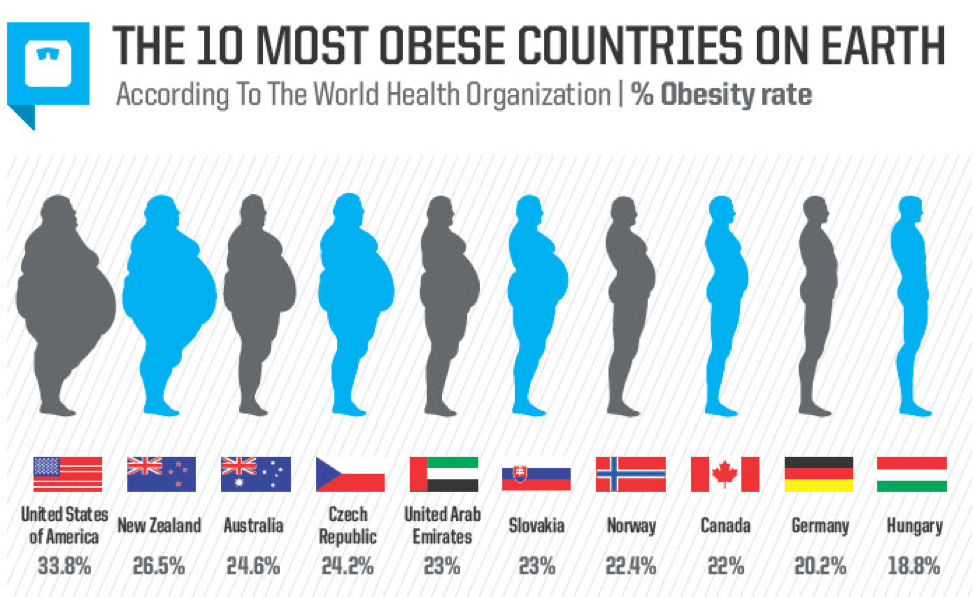
The United States healthcare system faces significant challenges like COID-19 that affect people as a whole and also impact the quality of care seekd for even when needed for other services. The Obesity input has been the nation’s greatest factor for decades that affects more Americans in this fashion, as it prevents each from having greater quality of care due to the obesity issue never gets addressed. Obesity is most commonly due to the individual caring an excess amount of weight or body fat, that in turn may affect the persons health due to body not functioning at its optimal performance. With large obese rates there has also been a trait of also reflects larger medical cost. An analysis by Commonwealth fund found that with the United States who is one of the leading nations in health care spending would spend an average of $9,086 per person annually, life expectancy was 78.8 years. When it comes to Switzerland the second highest nations of obesity also reflected the second highest spending when compared to the nations across the globe, spent $6,325 per person and had a life expectancy of 82.9 years (mohan, 2018.)
If we are to take this data and use it to access the impact of improving health by lowering weight in the United states, then we are able to assume that we are able to lower healthcare spending $2,761 per person. Comparing this again with New Zealand reports we are able to assume that overall health will also be largely impacted as the life expectancy would increase to 82.9 year, 4.1 more years then currently. Because people with obesity are more likely to develop a number of potential health issues consist and are not limited to heart disease, stroke, type 2 diabetes, certain cancers, digestive problems, gynecological and sexual problems, sleep apnea, and osteoarthritis are only some of the key issues provided by Mayo Clinic. The nations rates for members that suffer with medical issues in those areas will also decrease as having a healthy body weight lowers the risk of attracting an illness of that sort. As we have seen not all quality measures have equal impact and prevention on our healthcare as projections ambition, but by drawing attention to the issues to address the nation can use its healthcare spending more wisely to eliminate some of those challenges that may be faced.
In the nation’s healthcare system its evident that citizens often to not acquire the medical needs needed even after the U.S. spends a significant larger amount per person then compared to other nations. To improve open this more resources have been implemented like preventive care that consist of healthcare services that include check-ups, patient counseling, and screenings to prevent illness, disease and other health-related problems (kagan, 2019.)” But many of those benefits only prove to benefit those who are insured but many members in need for medical care who are the uninsured
The lack of quality care services has demonstrated to impact insured, uninsured, and under-insured Americans. “These problems are exacerbated by a lack of coordination of care for patients with chronic diseases. The underlying fragmentation of the health care system is not surprising given that health care providers do not have the payment support or other tools they need to communicate and work together effectively to improve patient care (Brennan, 2019.)”
With our current healthcare structure even though people seek medical attention that does not mean that all get the necessary medical attention. Working in the Emergency Room I noticed many medical resources being implemented in the wrong areas. If a person came in with head aces and was insured then that person would most likely have more medical procedures like a MRI, CT, X-ray, and a variety of labs are done to identify an issue. This creates a large amount of medical resources used that will not have an appropriate impact on the individual’s health but only incorporates a larger cost to that person for medical care and will incorporate a larger cost to address the solution of the problem. By providing an excessive amount of services will cause a “limited evidence on which treatments and procedures are most effective, limited evidence on how to inform providers about the effectiveness of different treatments, and failures to detect and reduce errors further contribute to gaps in the quality and efficiency of care (Brennan, 2019.)”
This impact does only affect the insured but largely the uninsured, as medical cost increase larger the further away uninsured individuals are able to afford the medical treatments needed. Nialle Brennan summarized in her article Improving Quality and Value in the U.S Healthcare System that when it comes to receiving medical care these issues are particularly more relevant to lower-income Americans and to members of diverse ethnic and demographic groups who are in great disparities in health and health care access.
“In 2018, the number of people in the United States without health insurance rose to 27.5 million, up from 25.6 million in 2017. The uninsured rate jumped from 7.9 percent in 2017 to 8.5 percent in 2018. It was the first year-to-year increase in uninsured rates since 2008 and 2009 (Scott, 2019.)”
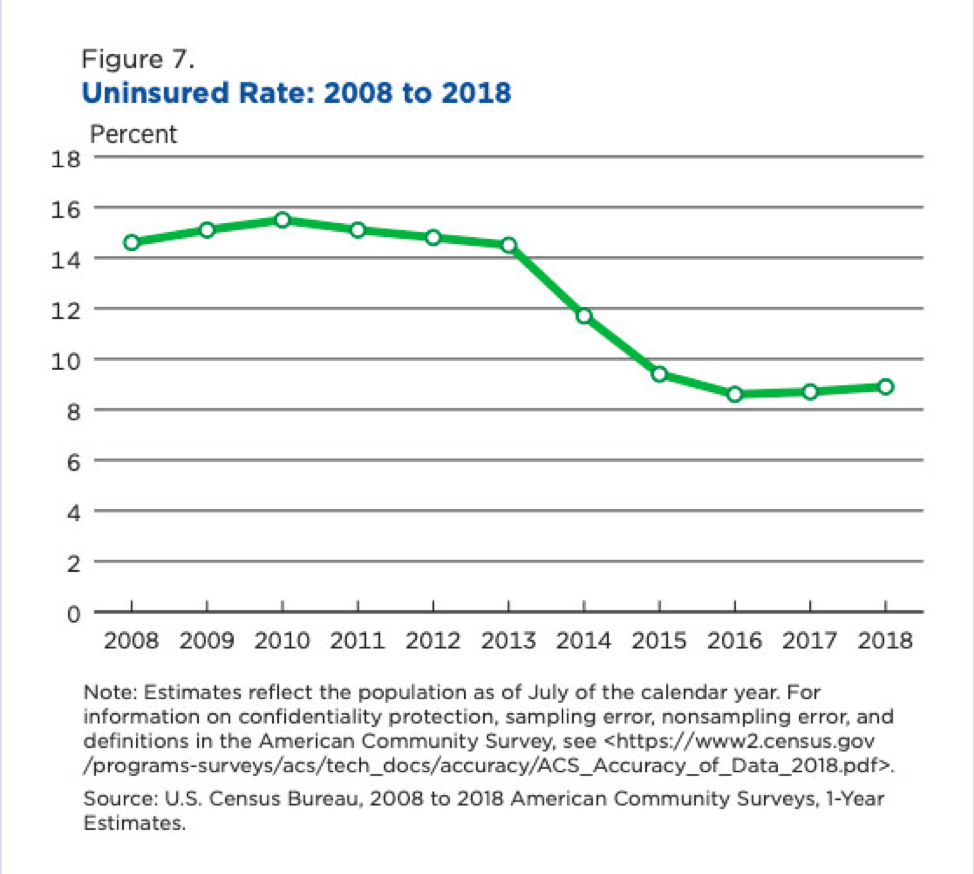
Every person will need medical attention at a certain point in their life. If the person is uninsured then they may not keep medical attention when needed only growing the need for medical care with each passing day. When they finally get medical care, the illness is so advanced that preventative care is not able to help and the medical care cost are much larger. This forces many Americans to decide “do I want to be healthy and in det or clear of det but unhealthy.” With thoughts of this sort the United States health standing will never have a change and only see a greater impact on our health negatively. Knowing when to address issues like obesity so it doesn’t affect one’s health is key to identify before chronic conditions present themselves.
As we have seen not all quality measures have equal impact and prevention on our healthcare as projections ambition, but by drawing attention to the issues to address the nation can use its healthcare spending more wisely to eliminate some of those challenges that may be faced. The evidence for reforming our nations healthcare system demonstrates tremendous potential to aid in not only improving the nation’s health as a whole, but also allocation of resources in the needed areas. In doing so the cost per service will decrease allowing for a more accessible healthcare system then our current functionality.
Word Cited
By Adam Mejia

The healthcare industry is one of the world’s largest industries that will be in need till the end time. The field has shown to continuously change with every passing year and with the advancement of technology many look to improve their way of help and an aging population causes a growing need for care. Many technological advances made are done to contribute to care in this industry. From pharmaceuticals to new surgical devices lives are saved every passing day due to new advances in healthcare. As a greater understanding in providing care is made so does the importance of management to understand for budgeting so those advancements can be made. Within this short blog I will reflect upon the key points of healthcare financial management regarding capital budgeting. It will also provide points to why it important for management to have a full understanding of those key points for effective operations for the organization.
Capital budgeting is often defined as a “planning process that can determine if a long-term investment, expenditure, and major capital should be pursued by the organization (Boundless.com, 2016).” Capital budgeting or investment appraisal is used by executives and management to make many large investment decisions such as new systems or equipment. In hospitals this big budget expenses usually means new medical equipment to provide better care like an MRI machines, CAT Scans, Ultrasounds, and more.
Capital budgeting plans are crucial for the success of the healthcare facility because without it then the facility will not budget for the funds needed for that medical equipment. If an MRI machine has meet its life’s end for a clinic, then the capital budget plan comes to pay. If not plan is in place then the clinic may not be able to replace the necessary equipment and at worst means the clinic must close down.
Making the most effective decisions is one of the most important factors for long term success. This leads me to my next point for why it important for management to have a full understanding for how to effectively budget. Healthcare organizations who brace for what lies ahead are better prepared for changes as they come. “With healthcare markets changing day-to-day, it is not always easy to determine where funds are best spent, and how capital budgets should be balanced. However, those who are ready for the many possibilities of what the future may hold for the healthcare industry, can better strategically plan their financial future (Banks, 2018).”
To prevent a negative event from happening facilities must take note of the fallowing points.

Making sure the organizations plans, models, and budgets all align are key point for success. For all plans to align the organization must set quarterly goals and touch base to make sure all plans stay in place. Refinements are made with the proper collaboration with every department. When done effectively the budgeting process gives the organizations leaders a vision into how baseline projections and new initiatives are impacting by managements financial plan. If management does not plan for replacements of equipment, then they will demonstrate a massive loss of patients as an area of care they provide would be eliminated. “Multi-year planning enables organizations to understand not only the impact external market business drivers will have on bottom-line results, but also internal initiatives. Baseline assumptions (current outlook 3-5 years), combined with independently modeled initiatives projecting the impact of targeted growth strategies or cost containment efforts, can be used to evaluate different “scenarios” (Kaufmanhall, 2017.)”
In an ever-changing industry organization must establish the correct strategic relationship to adjust for the potential change in volume, workload, revenue, and other barriers that the organization may see well the facility aims for more growth in its field. All factors change as revenue is limited if workload is limited as well. It’s important for management to see and understand such events to better shift time and resources for more effective use. You don’t want to have two people doing one job. To do so Kaufmanhall listed 4 key steps for facilities to keep in mind.
With more and more organizations using technology to improve care, many facilities are using technology to analyze threats that may be seen in the future. Organizations have shifted care by incorporating patient centric data into different plan models for more accurate volume projections for the facility. “Consistent use of service line volume, cost, and profit measures across multi- year plans, forecasts, and budgeting models aligns key functions such as market planning, physician recruitment, and revenue forecasting. Such analytics integrate the volume planning with revenue planning so future reimbursement rates can be modeled more precisely by clinical population ( Banks, 2016).” If the life spand for an equipment costing over $500k is projected to be 10 years, then the facility is able to start planning and budgeting for such technology now as the equipment is so expensive saving for it will for when needed.
For organizations to improve there must be a baseline on where they should be and a like where they are looking to improve on. Budgets, baseline, and planning are all comprised of sets of assumptions on the best course of action. In many cases due to the many departments, a large variety of assumptions are made to better serve the organization. To add, “initiatives modeled separately allow organizations to evaluate how directed efforts related to growth, cost containment, or process improvement will (or should) impact functional departments (Kaufmanhall, 2018).” To identify the best approach the management team must come together with different approaches that will benefit the organization as a whole well keeping interest on how to better serve members in there department. This plan should keep in mind that funds maybe limited for each area.
Every process can be improved in some form. Once organization set a baseline then they are able to look for ways to improve from it. Once reporting is collected from this baseline then areas to improve upon are identified so management knows where attention should be focused on. This will create an improved feedback to review at a later time to identify if changes have been made or if changes must be made again. “Notifications related to report readiness or outlier variances should proactively notify users by pushing notifications to inboxes or phones. Ideally, explanations and commentary are part of the reporting process. Managers must understand “what” outliers exist and then offer commentary around “why” (Kaufmanhall, 2018).”
Conclusion
Most Managers must have an understanding of different budgeting requirements for sound business decisions. Budgeting requires for careful consideration to aid with effective planning. As our knowledge of these matters expands, the care in which patients receive expands as well. This short blog provided a look into what key points management should keep in mind when looking for more effective decisions.
Word Cited:
capitalbudgetingforhealthcare, A. (2016, August 15). Capital Budgeting for Healthcare. Retrieved December 19, 2019, from https://capitalbudgetingforhealthcare.wordpress.com/2016/08/15/capital-budgeting-for-healthcare/.
Banks, k. (2018, November). The Importance of Budgeting in Business: WLF Accounting & Advisory. Retrieved December 20, 2019, from https://wlf.com.au/importance-budgeting-business/.
Kaufmanhall. (2018). Healthcare News. Retrieved December 21, 2019, from http://pages.healthcareitnews.com/rs/himss/images/ebook-hc-budgeting-approaches-kha_revised7.pdf?aliId=88003541 .
This is an example post, originally published as part of Blogging University. Enroll in one of our ten programs, and start your blog right.
You’re going to publish a post today. Don’t worry about how your blog looks. Don’t worry if you haven’t given it a name yet, or you’re feeling overwhelmed. Just click the “New Post” button, and tell us why you’re here.
Why do this?
The post can be short or long, a personal intro to your life or a bloggy mission statement, a manifesto for the future or a simple outline of your the types of things you hope to publish.
To help you get started, here are a few questions:
You’re not locked into any of this; one of the wonderful things about blogs is how they constantly evolve as we learn, grow, and interact with one another — but it’s good to know where and why you started, and articulating your goals may just give you a few other post ideas.
Can’t think how to get started? Just write the first thing that pops into your head. Anne Lamott, author of a book on writing we love, says that you need to give yourself permission to write a “crappy first draft”. Anne makes a great point — just start writing, and worry about editing it later.
When you’re ready to publish, give your post three to five tags that describe your blog’s focus — writing, photography, fiction, parenting, food, cars, movies, sports, whatever. These tags will help others who care about your topics find you in the Reader. Make sure one of the tags is “zerotohero,” so other new bloggers can find you, too.

 Assess Capital Decisions